
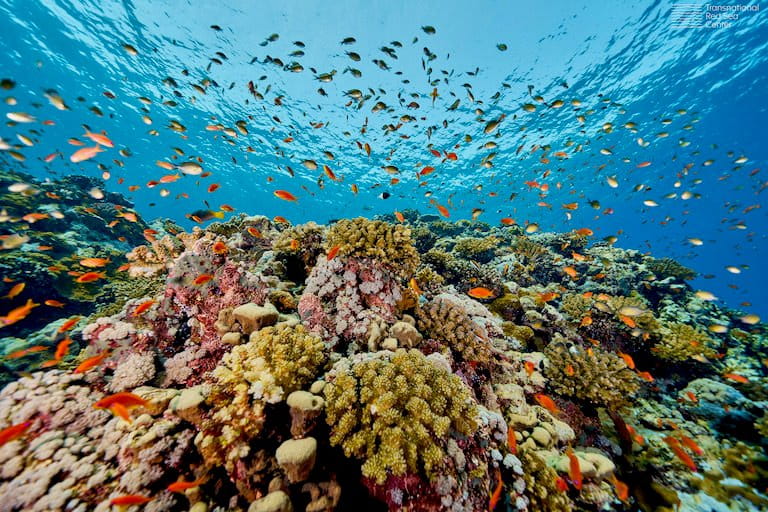
Reefs of Hope in a Warming World
Protecting the Red Sea’s Climate-Resilient Corals
Here’s some rare environmental good news. An initiative based in Switzerland is helping safeguard one of the planet’s most climate-resilient coral reef systems at a moment when reefs worldwide are in steep decline.
Coral reefs are diverse underwater ecosystems built by tiny coral animals that secrete limestone skeletons, forming intricate structures that support thousands of marine species. They act as critical nurseries for fish, protect coastlines from storms and erosion, and support millions of people through fisheries and tourism. Despite covering less than 1% of the ocean floor, reefs are vital to ocean health, global biodiversity, and human livelihoods.
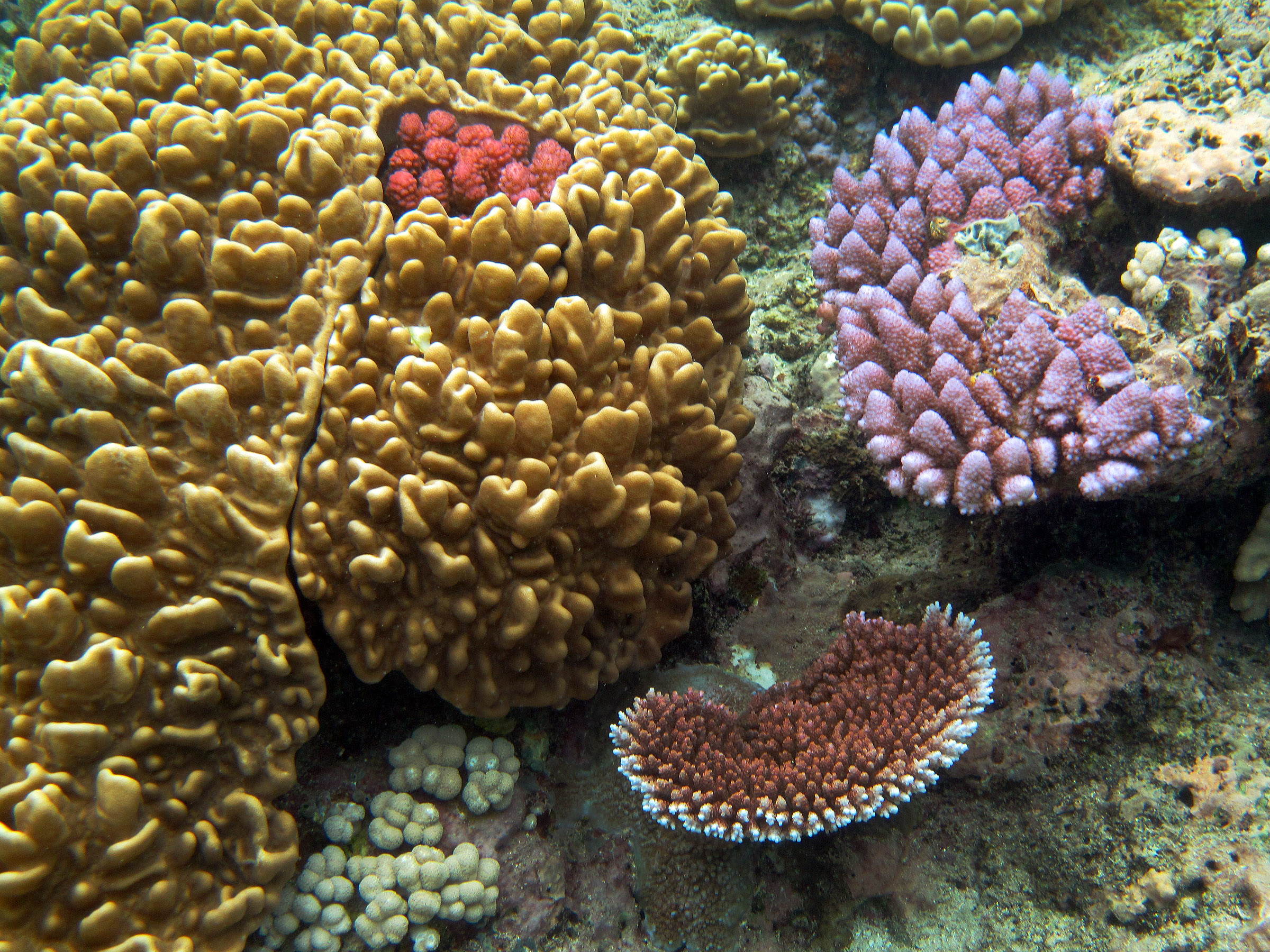
Great Barrier Reef. Photo: Steve Evans. License: Attribution-NonCommercial 2.0 Generic (CC BY-NC 2.0)
Why “Reefs of Hope”?
Over the past decade, studies have shown that corals in the northern Red Sea, especially in the Gulf of Aqaba, can tolerate heat far beyond thresholds that trigger mass bleaching elsewhere. Experimental and field research has documented corals surviving extreme thermal anomalies, positioning the region as a potential global refuge for coral reefs as oceans warm. Environmental reporting has echoed this assessment, highlighting the Red Sea as one of the few places where corals appear to be resisting climate-driven collapse. The corals there have thus been named the “reefs of hope.”
The Transnational Red Sea Center
The Transnational Red Sea Center (TRSC), hosted at EPFL, Switzerland’s federal institute of technology, brings together scientists, policymakers, and regional partners to protect the Red Sea and its source waters. Launched in 2019 with the official support of the Swiss Federal Department of Foreign Affairs, the Center blends cutting-edge marine science with diplomacy to protect what are increasingly call the world’s “reefs of hope.”
TRSC’s mission is concrete and collaborative: advancing research and conservation across the Red Sea and its source waters while building a regional coalition capable of turning science into protection. The Center explicitly frames its work as “bridging science and diplomacy.” It leverages Switzerland’s neutrality to convene researchers and decision-makers from across a geopolitically complex region.
On the ground, this involves coordinating reef-monitoring baselines along the Red Sea’s full length, including developing observation tools such as machine-learning-assisted monitoring. The Center also organizes joint expeditions and training programs with local institutions to ensure consistent data collection across countries.
A Race Against Global Coral Loss
The urgency behind this work is stark. Scientists estimate that around 50% of the world’s coral reefs have been lost in recent decades. What’s more, scientific projections indicate that without rapid emissions cuts, 70–90% of warm-water coral reefs could disappear by mid-century, leaving only a small fraction intact.
Against this backdrop, the Red Sea’s resilience stands out. Policy analyses and foundation-backed research programs increasingly describe the Gulf of Aqaba as potentially among the last coral reef systems with unique natural resilience able to withstand severe warming, provided local stressors like pollution and overfishing are kept in check.
Why Oman’s Coast Matters
TRSC’s work extends beyond the Red Sea itself into its source waters, where large-scale oceanographic processes shape reef conditions. Oceanographic studies show that water masses originating in the Arabian Sea and the Gulf of Oman are physically connected to the Red Sea system. High‑salinity Red Sea waters flow into the Arabian Sea, and monsoon‑driven upwelling shapes nutrient and temperature patterns that help scientists understand regional marine conditions. These processes provide important context for understanding how Red Sea reefs respond to environmental stressors and for guiding conservation strategies across the region.
Studying how these processes interact helps scientists anticipate future stressors and identify conditions that may support coral survival elsewhere.
Science Diplomacy in Action
No single country can protect this ecosystem alone. According to an EPFL-affiliated event description, TRSC’s regional approach bridges science and diplomacy. It involves all eight countries bordering the Red Sea (Saudi Arabia, Djibouti, Egypt, Eritrea, Israel, Jordan, Sudan, and Yemen) in collaborative research and conservation efforts.
The TRSC also collaborates with international coral networks and academic partners to encourage cross-border knowledge exchange and coordinated action. One example is the Global Coral Reef Monitoring Network, which connects scientists and partners worldwide to share data, build capacity, and coordinate reef monitoring and conservation efforts.
Lessons for Reefs Worldwide
The stakes go far beyond the Red Sea. Corals in the northern Gulf of Aqaba can survive heat levels that would normally bleach and kill most other reefs. In a record marine heatwave with sea surface temperatures about 3–3.5 °C above the local summer maximum, its common coral species showed remarkable resilience and did not bleach. Studying how these corals cope with extreme temperatures, including their biology and partnerships with microscopic algae, could provide valuable insights for protecting and managing reefs around the world.
By pairing advanced monitoring with regional cooperation, the TRSC offers a model for protecting a living laboratory of resilience while translating its lessons to reef systems worldwide.
A Living Laboratory of Hope
In short, the TRSC is helping keep a vital option open. By safeguarding the Red Sea’s “reefs of hope” and their source waters, including Oman’s influential coastline, it is preserving biodiversity, supporting local livelihoods, and protecting scientific insights that could help reefs everywhere survive a hotter future.
It’s a rare example of hopeful, hard-headed collaboration – exactly what this century needs.
Featured image: Red Sea Coral. Courtesy of Transnational Red Sea Center. Photo by Guilhem BAN PRANDI