
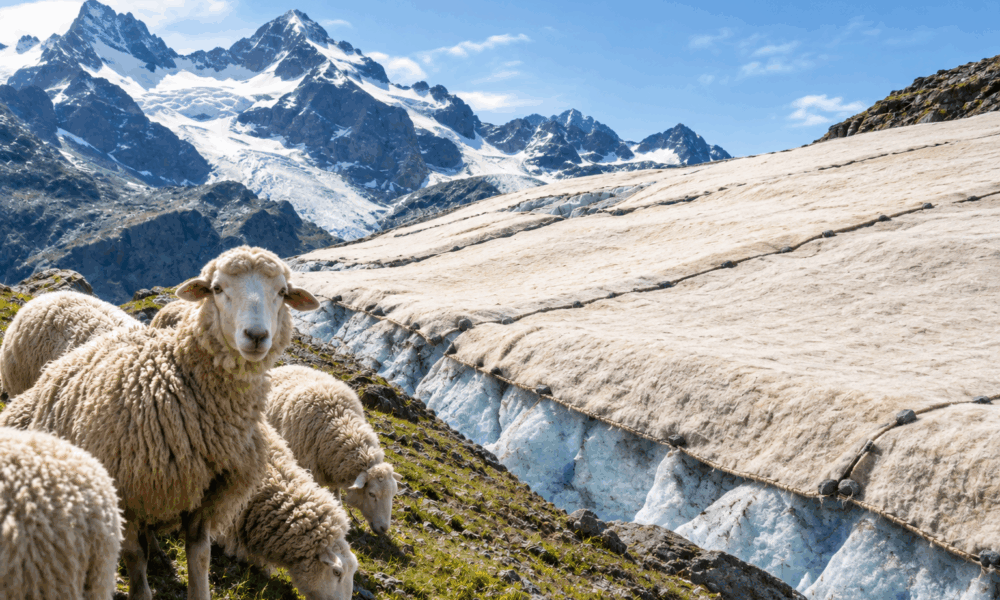
Could Sheep’s Wool Help Save Glaciers?
A Swiss experiment is turning an unlikely waste product into a natural shield against melting ice.
Glaciers may seem indestructible but they are disappearing rapidly. Just in Switzerland, according to the Swiss Glacier Monitoring Network (GLAMOS), the country had about 45.1 cubic kilometers (roughly 10.8 cubic miles) of glacier ice at the end of 2025. That’s roughly 30 cubic kilometers less than in 2000. The GLAMOS glacier report asserts that from October 2024 to September 2025 alone, glaciers lost approximately 3% of their remaining volume.
Now, an unusual material is being tested to help protect them: sheep’s wool.
In June 2026, the “Keep It Wool” project installed two 10-by-10-meter (about 1,076 square foot) wool blankets on the Tsanfleuron Glacier at Glacier 3000 above Les Diablerets, in the canton of Vaud. A synthetic geotextile blanket of the same size was installed alongside them for comparison. The project brings together the Summit Foundation, a Swiss nonprofit environmental organization, and the University of Lausanne, with scientific expertise from GLAMOS.
Why Save Glaciers?
Glaciers are far more than spectacular mountain scenery. They act as natural water reservoirs, storing precipitation for years, decades, or even centuries. They release this water during warm, dry periods. Switzerland’s glaciers contribute to the flow of major rivers, including the Rhine and Rhône, making them important for water supplies, agriculture, and ecosystems.
They also matter for energy. More than half of Switzerland’s electricity comes from hydropower, and glacier melt currently contributes to water flows used for electricity generation. In the longer term, however, shrinking glaciers mean less meltwater and a less predictable water supply.
Glaciers also help regulate the climate. Their bright snow and ice reflect a significant proportion of incoming sunlight rather than absorbing it. That phenomenon is known as the albedo effect. As white, reflective surfaces disappear and darker rock or water is exposed, more solar energy is absorbed.
And glacier loss contributes to rising sea levels. The U.S. Geological Survey notes that glacier melting affects freshwater resources, ecosystems, and global sea level.
Why Wool?
For decades, some Swiss glaciers have been covered with synthetic blankets during the summer to reflect sunlight and reduce heat absorption. These coverings can significantly slow melting in the areas they protect.
But synthetic materials have an environmental drawback: they can shed plastic fibers as they weather. Sheep’s wool offers a much more natural alternative. It is renewable, biodegradable, locally available, and naturally insulating. What’s more, much of Switzerland’s wool currently has little commercial value. The Summit Foundation estimates that as much as 70% of Swiss wool is destroyed.
Instead of discarding some of this wool, we could potentially turn it into a protective blanket for the very landscapes that help sustain Switzerland.
Does It Actually Work?
So far, the results are encouraging.
After one summer of testing, the Summit Foundation reports that the two wool coverings provided protection comparable to the conventional synthetic geotextile. The “Keep It Wool” initiative took measurements every two weeks to monitor melting. Nevertheless, the full data still needs to be analyzed.
Previous glacier-covering projects have shown that such blankets can reduce melting by roughly 50-70% in the areas covered, according to Swiss public broadcaster SWI.
That is impressive, but there is an important catch. Protective blankets only cover about 0.02% of Switzerland’s glacier surface. They can slow melting in specific locations but they cannot stop the overall retreat of glaciers as temperatures rise.
A Small Step with a Big Message
Sheep’s wool will not solve the climate crisis. The most important way to protect glaciers in the long term is to reduce greenhouse gas emissions and limit global warming.
But “Keep It Wool” shows how climate action can sometimes begin with surprisingly simple ideas. Take a natural material that is being wasted, put it to useful work, and replace a synthetic product with something biodegradable.
It is a small blanket for a very big problem. But it’s an encouraging example of human ingenuity being put to work for the planet.