
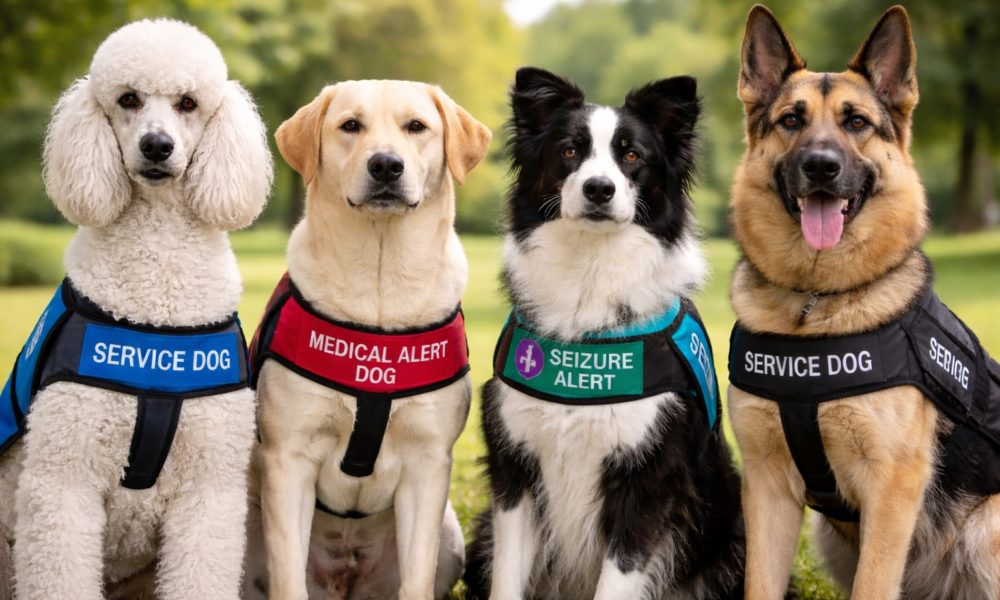
Super-Dogs: The Four-Legged Heroes Transforming Lives
Highly trained assistance dogs are detecting danger, restoring independence, and redefining care.
There’s something extraordinary happening in homes, schools, and hospitals around the world, and it walks on four legs. Known as “super-dogs,” medical assistance dogs are proving that compassion, intelligence, and training can combine into life-changing support for people with complex health conditions.
These dogs aren’t just companions. They are trained professionals.
From Puppies to Life-Saving Partners
Becoming a medical alert or assistance dog is no small feat. Training can take up to two years and involves teaching dogs to perform highly specific, disability-related tasks. These can range from retrieving medication to recognizing subtle physiological changes in their human partner’s body.
Under disability law, a service dog must be trained to perform tasks directly related to a person’s condition, making them more like a living medical device than a pet.
The Science Behind the Superpowers
One of the most astonishing abilities of these dogs is their sense of smell. In the case of diabetes, dogs can detect chemical changes in breath, sweat, or saliva that occur when blood sugar levels shift.
This allows diabetic alert dogs to warn their owners of dangerously high or low glucose levels, sometimes even before symptoms appear. In one study, over 91% of alerts occurred when blood sugar dropped into a risky range. What’s more, many users reported fewer severe episodes after getting a dog.
For people with epilepsy, the story is equally compelling. Some dogs can anticipate seizures anywhere from seconds to hours in advance, with reported accuracy rates of 70–85% in certain cases. Though scientists are still uncovering exactly how dogs do this, their sensitivity to human scent and behavior appears to play a major role.
Real-Life Heroics
So what can these “super-dogs” actually do?
- Seizure response: Dogs can stay close during a seizure, cushion falls, or even place themselves between their owner and hard surfaces to prevent injury.
- Emergency assistance: They can fetch phones, activate alert systems, or run to get help from others.
- Diabetes alerts: By detecting subtle scent changes, they warn owners of blood sugar fluctuations before they become dangerous.
- Autism support: Assistance dogs can provide calming pressure, interrupt harmful behaviors, and help children navigate overwhelming environments (widely documented across service dog programs).
- Daily independence: From opening doors to retrieving dropped items, these dogs help people live more independently.
For many owners, the biggest benefit isn’t just safety. It’s freedom. People who once feared leaving the house alone can now shop, travel, and work with greater confidence.
More Than Medical Tools
Beyond their technical skills, these dogs provide something harder to measure: emotional stability. Studies and reports consistently show improved quality of life, reduced anxiety, and increased participation in everyday activities among their owners.
For someone living with an unpredictable condition, that peace of mind can be transformative.
A Partnership Built on Trust
It’s important to note that not every dog can become a “super-dog.” Success depends on temperament, training quality, and the bond between dog and handler. And while their abilities are impressive, they are not flawless. Science is still catching up to fully explain or standardize some of their skills.
But for those who rely on them, the impact is undeniable.
In a world increasingly driven by technology, these remarkable animals remind us that qualities we associate with humans – loyalty, intuition, and connection – sometimes offer the most powerful solutions.
Sometimes, a hero doesn’t wear a cape.
Sometimes, it wags its tail.

Great and uplifting story, very interesting details.