
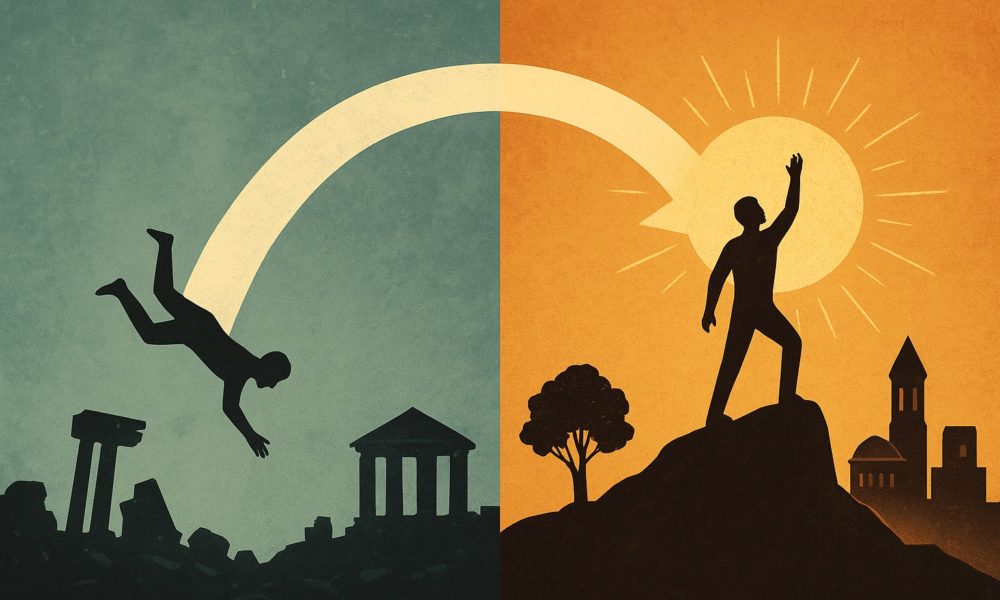
From Ruin to Renewal: Humanity’s Fall and Rise
Today’s challenges can ignite a bold new era of progress.
Throughout human history, we can see recurring cycles of crisis and collapse but also, critically, resilience and renewal. Today, when we face environmental degradation, climate change, social fragmentation, and existential risk, it is important to remember that our ancestors have weathered dark times before, and emerged stronger, more creative, and more prosperous. Their stories offer not only warning but also inspiration: we can reverse destructive trends, restore flourishing, and build a future that enhances human dignity and protects the Earth.
Lessons from the Past
One of the clearest historical examples of decline followed by flourishing is Europe in the late Middle Ages. In the 14th century, the continent suffered a series of catastrophic shocks: the Great Famine (1315–1317), the Black Death (1347–1351), political instability, wars, and financial collapse. These crises severely reduced the number of people. Europe’s population may have fallen to roughly half of its pre-crisis level of 70 million people in 1300. Yet, remarkably, by the late 14th and 15th centuries, recovery had begun. The institutions that survived – local communities, religious structures, trade networks – rebounded, and Europe entered a period of renewed growth in the early modern era.
Another illustrative case comes from the collapse of the sophisticated Classic Maya civilization in Mesoamerica around 800–950 CE. In our modern-day countries, the area spanned southern Mexico, Guatemala, Belize, western Honduras, and northwestern El Salvador. At the time, urban centers such as Tikal, Palenque, and Copán declined. Their populations shrank and political structures weakened. The cities stopped producing their iconic carved monuments that recorded rulers, rituals, and historical events. Many cities were abandoned.
The Mayan decline is not fully understood but archaeological and paleoclimatic studies point to a combination of factors: environmental stress (prolonged drought, deforestation, paving), resource depletion (unsustainable agriculture, water scarcity), and sociopolitical pressure (social unrest, strained labor systems, dwindling trade, internal political tensions). But “collapse” did not mean the end of the Maya people. In the centuries that followed, new power centers emerged, such as Chichén Itzá and Mayapán, and Maya culture continued, demonstrating resilience and adaptation over time.
We also see structural transformation after collapse in earlier contexts. The Byzantine “Dark Ages” of approximately the 7th and 8th centuries witnessed great upheaval: the empire experienced territorial losses, economic contraction, population decline, disruptions to education and urban life, and widespread social change. Yet by the 9th century a revival emerged, with renewed intellectual life, political stability, and cultural flourishing, which some historians call the “middle Byzantine renaissance.”
Ancient examples are equally instructive. After the collapse of the Mycenaean palatial civilization around 1200 BCE, Greece entered what scholars call the “Greek Dark Age,” lasting until roughly 800 BCE. During this period, the Mycenaeans lost the writing system they had used to keep records of goods, taxes, and administrative matters. Importantly, long-distance trade declined, populations shrank, and many settlements were abandoned. But over the following centuries, new social forms and a new alphabet developed. At the same time, emerging city-states gave rise to distinctive art, architecture, and political institutions. This transformation laid the foundation for Archaic Greece. Authoritative archaeological syntheses summarize this trajectory from collapse to cultural and institutional reinvention.
These cycles of decline and revival are not just accidents of history. Climate stress has played a recurring role. Studies show that environmental shocks, including droughts, famines, and epidemics, often contributed to societal breakdown. But societies have also built resilience: according to recent research, some communities endured repeated climate stress and still flourished. A thoughtful historical analysis from the Belfer Center argues that climate recovery helped sustain societies after collapse, allowing them to rebuild.
Why These Histories Matter Today
Our present moment may feel apocalyptic. We see environmental degradation, biodiversity loss, climate change, rising inequality, political polarization, and technologies that can both empower and threaten. Yet, the past offers a hopeful lesson: human societies are not bound to follow a single trajectory of decline.
First, the examples of European, Maya, Byzantine, and Greek societies show that collapse does not necessarily mean the end. Rather, complexity can re-emerge. Humans reinvent political institutions, cultural systems, and social bonds.
Second, resilience is not automatic but can be cultivated. In the past, communities survived by leveraging local institutions, adapting through innovation, and renewing their social contracts. Today, we can foster similar responses: investing in ecological restoration, strengthening community networks, expanding sustainable technologies, promoting justice, and rethinking economic systems.
Third, the fact that climate shocks repeatedly triggered instability underscores the urgency of ecological stewardship. Just as earlier societies reeled from droughts or disease, we must address global warming, resource depletion, and environmental stress as core to our long-term survival and flourishing.
Toward a New Era of Dignity and Opportunity
So how can we translate these insights into practical hope?
- Build resilience through community: Support local, democratic structures that are flexible, inclusive, and rooted in shared purpose. These were the very institutions that helped medieval Europe rebound.
- Invest in regenerative technologies: Promote renewable energy, circular economy models, and nature-based solutions. This echoes how past societies adapted technologically to new climates.
- Align freedom with responsibility: Our capacity to innovate and communicate globally is more powerful than ever. But with power comes responsibility: to preserve human dignity, equitable access, and ecological balance.
- Foster a renewal ethos: Just as the Renaissance rediscovered ancient wisdom in a transformed world, we can build a sustainability renaissance, combining science, ethics, and compassion to reimagine what flourishing means in the 21st century.
In short, human history is not a linear march toward inevitable decline. It is a tapestry woven with cycles of challenge and renewal. Today, we face urgent environmental, social, and political perils. But we also have unmatched capacity to respond, rebuild, and re-envision our world. We can learn from the past. We can turn crisis into opportunity and chart a future of dignity, freedom, and care for both humanity and our planet.