

The New Layer: How 3D Printing Is Changing What’s Possible
Imagine a world where prosthetic limbs adapt perfectly to your body, where organs might one day be printed, fashion is made to order, and houses rise in days – not months – all while minimizing waste. That world is not science fiction. It’s being shaped now through advances in 3D printing, or additive manufacturing. Below are some exciting real‐world applications, the benefits, but also some risks we must face.
Real‐World Applications and Examples
Three areas where 3D printing is having a transformative impact are medicine, fashion, and construction.
Medicine
Hospitals are already using patient-specific implants and prosthetics created with 3D printing technology, perfectly matching the shape of bones or residual limbs. This leads to better fit, improved comfort, and faster healing.
Surgeons also rely on 3D-printed anatomical models to prepare for complex procedures. For instance, at SJD Barcelona Children’s Hospital, a life-sized replica of a child’s tumor was printed so that the surgical team could rehearse a challenging operation before performing it on the patient.
Beyond this, researchers are making strides in bioprinting, where living cells serve as “ink” to create tissues, and in the future potentially entire organs. One example, reported in the journal Bioengineering, involves a case of severe narrowing of the aortic valve, the heart’s main opening. The “clinicians can promptly download and print the blueprint for a new aortic valve. With the advancements in bioprinting, the valve can even be printed using bioinks, such as collagen, closely resembling native tissue valves, or utilizing the patient’s own valvular cells [specialized cells making up the heart valve] for a truly personalized product.” This represents a promising avenue for addressing chronic organ shortages.
Fashion
Fashion is another industry in which 3D printing is opening new creative and manufacturing possibilities. Designers are experimenting with printed garments, accessories, and footwear. They often use recycled or bio-based materials to reduce waste and support more sustainable, on-demand production. While the technology is not yet widely used for everyday clothing, it has the potential to minimize material waste and enable more customized manufacturing.
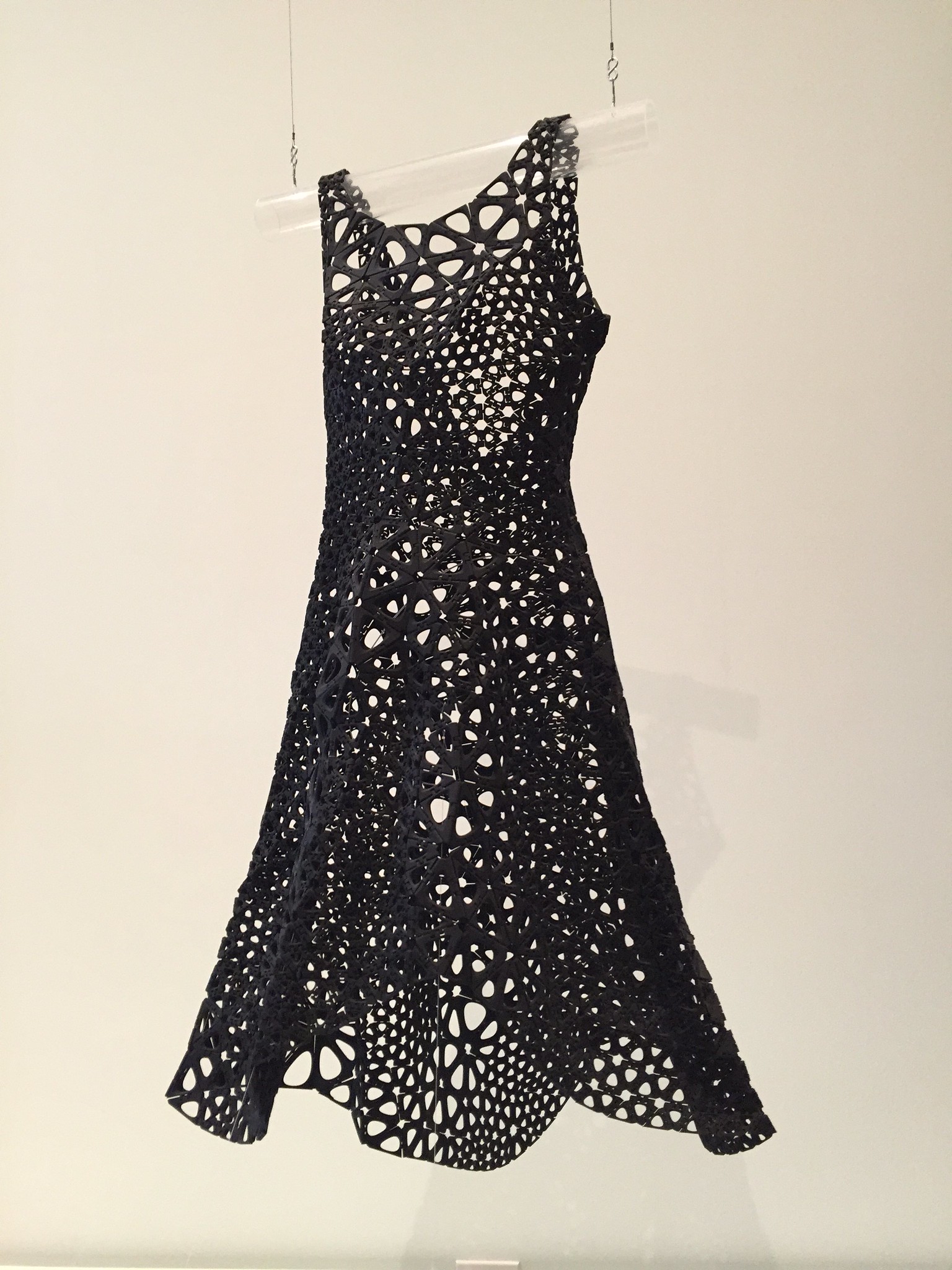
3D printed dress (photo: Karl Schultz via Flickr, CC BY-NC-SA 2.0 license)
A notable example is the collaboration between Italian materials company Balena and designer Brigitte Kock. Pieces created from BioCir®flex3D, a flexible bio-based material, combine aesthetics, comfort, and sustainability.
Construction
3D printing technology is transforming the way we build. The TECLA house in Italy is a striking case in point. Two synchronized robotic arms printed the house using a locally sourced clay-based mixture containing sand and natural fibers. The project shows how sustainable housing can be created with minimal waste and a reduced environmental footprint.
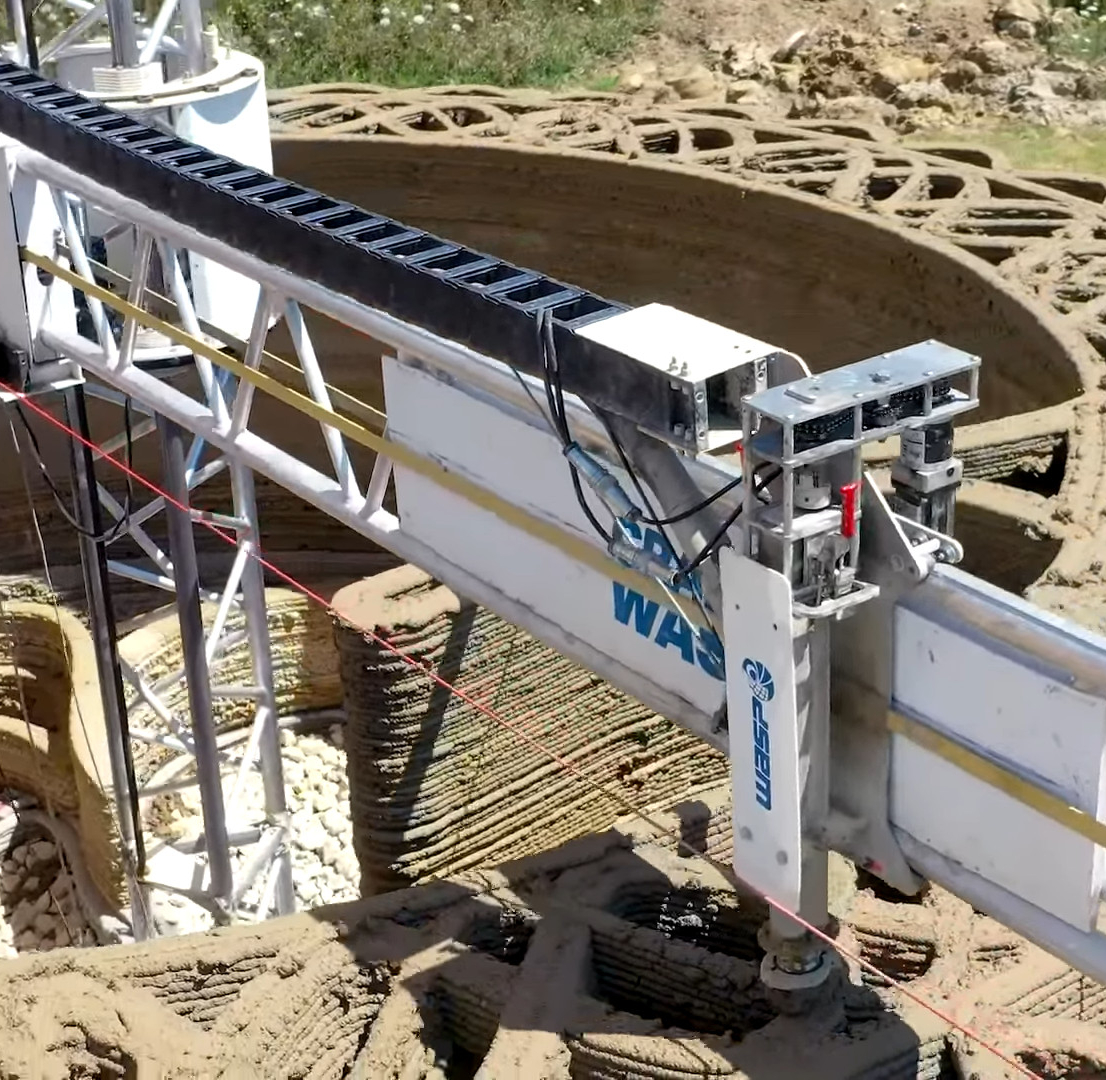
Crane WASP 3D-printer arm used to build the TECLA supporting structure (photo: Alfredo Milano; drone views: Italdron; via Wikimedia Commons, CC BY 2.5 license)
In another example, U.S.-based firm Azure Printed Homes is giving plastic waste a second life by turning recycled polymers into modular homes. The company has supplied housing units for projects such as Veterans Village (California, USA). It demonstrates how recycled materials can help create more sustainable and affordable housing. Companies report that this manufacturing process can reduce construction time by as much as 60%. It also lowers labor requirements and minimizes material waste compared with conventional building methods.
Key Benefits
Looking across these industries, the benefits of 3D printing stand out. Here are some of the biggest advantages driving this growing popularity:
- Lower costs: 3D printing significantly reduces costs by eliminating the need for expensive tooling, reducing manual labor, and avoiding costly factory retooling.
- Faster production and shorter lead times: Prototypes, custom parts, surgical models, and even houses can move from design to final production much more quickly using additive manufacturing.
- Greater customization and personalization: 3D printing makes it possible to produce patient-specific medical implants, bespoke fashion pieces, and tailored housing designs that meet individual needs.
- Improved solutions to organ transplant shortages: Bioprinting and patient-specific implants could help reduce dependency on donor organs and lower the risk of transplant rejection in the future.
- On-demand production and minimized inventory: Because objects can be printed when needed, businesses can reduce storage costs, avoid overproduction, and streamline supply chains.
- Higher resource and material efficiency: Additive manufacturing uses only the material necessary for production, which leads to less scrap and more efficient use of resources.
- Reduced waste and lower storage costs: 3D printing cuts down on excess production, offcuts, and unused inventory, resulting in lower waste and lower associated storage expenses.
- Seamless integration with Industry 4.0 technologies: 3D printing works seamlessly with digital design, robotics, artificial intelligence, and data-driven systems to enable mass customization and more automated production.
- Stronger alignment with circular economy goals: By using recycled materials, local resources, and bio-based feedstocks, 3D printing helps close material loops, minimize transport emissions, and lower the overall environmental footprint.
Risks and Challenges
Of course, 3D printing is not a panacea. Despite its promise, it still faces significant challenges. Material limitations remain an obstacle, as not every material can be printed with the required durability, strength, or biocompatibility. Ensuring quality and consistency across batches, especially in critical applications like medical devices or housing, is another concern.
In some cases, 3D printing is still impractical for large-scale or high-volume products, where traditional manufacturing remains faster or more economical. The cost of high-end printers and skilled operators can also be a barrier for widespread adoption. Ethical and regulatory considerations must also be addressed, particularly in bioprinting. Here, questions of consent and the definition of organ donation can become complex.
Additionally, 3D printing consumes energy and, depending on the materials used, there can be concerns over chemical toxicity or environmental impact. Some 3D-printed products require extensive post-processing to achieve the desired surface finish or strength. This can add time, cost, and waste back into the process.
3D Printing and the Circular Economy
One of the most compelling reasons to embrace 3D printing is its potential to accelerate the shift toward a circular economy. By using recycled plastics, local natural resources, and bio-based feedstocks, additive manufacturing helps close material loops and keeps valuable resources in use.
Its ability to produce items on demand means fewer unsold products and less inventory waste. Local production can also reduce transportation emissions and carbon footprints. This approach helps the environment and builds more resilient, decentralized supply chains. That’s a key step toward tackling the environmental and social challenges of the 21st century.
Looking Ahead
3D printing is already transforming manufacturing, medicine, fashion, and housing. 4D printing is here, too, and it’s just as revolutionary. In 4D printing, the fourth “dimension” is time. Instead of producing static objects, 4D printing uses smart materials, such as shape-memory polymers, hydrogels, or composites. These materials can change their shape, function, or properties over time. They respond to environmental triggers like temperature, moisture, or light, making them essentially programmable materials.
As materials improve, regulations adapt, and costs fall, we can expect even more radical shifts. In the near future, researchers may print organs for transplantation on a wide scale, builders may construct housing in record time for disaster relief, and designers may create fashion pieces that fully biodegrade or can be endlessly recycled. Beyond that, we might see spacecraft parts printed in orbit and custom foods created on demand to meet individual nutritional needs. Entire cities could even be designed and printed with zero waste.
Fully realizing these advances will require investment in research, ethical oversight, standards, and sustainable materials. But if done right, additive manufacturing could become one of humanity’s most powerful tools. It could help build a smarter, more sustainable, and more equitable future.