
We Are All Immigrants: The Trailblazers Who Crossed Borders and Changed History
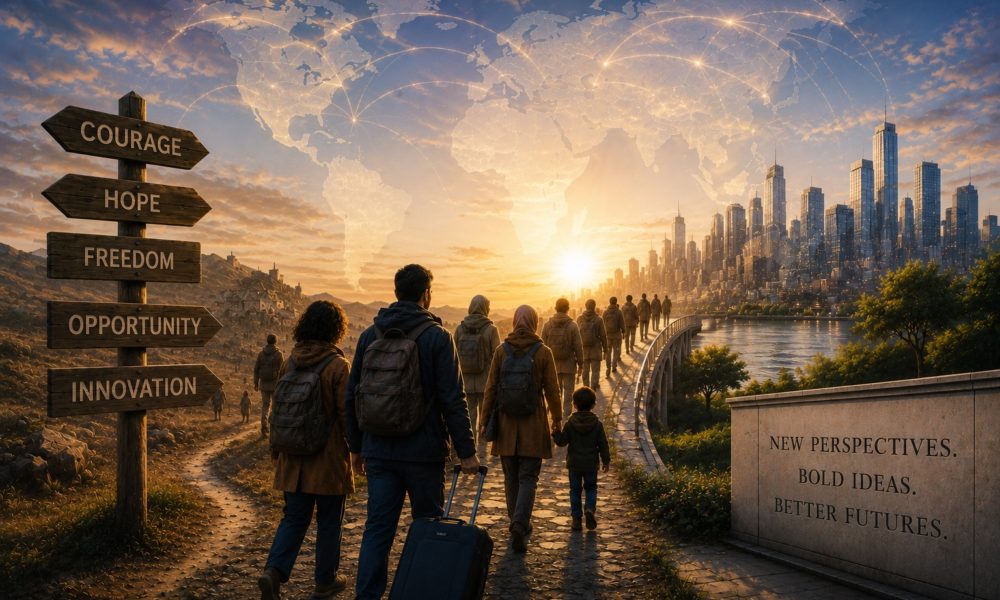
Across history, immigrants have brought new perspectives, transformed societies, and sparked innovation. They have contributed to making the world a better place. These visionaries have defied borders and barriers to shape science, culture, justice, and other areas of human endeavor. The following men and women illustrate the transformative power of migration, a story not of loss, but of contribution, courage, and shared humanity.
Frédéric Chopin: The Exile Who Transformed Classical Music
Poland → France
When Frédéric Chopin (1810-1849) left his native Poland in 1830, he could not have known that he would never return. Shortly after his departure, an uprising against Russian rule was crushed, making his exile effectively permanent. He settled in Paris, then one of Europe’s leading cultural capitals, where he became one of the most influential composers and pianists of the 19th century.
Drawing inspiration from Polish folk traditions while embracing the artistic life of France, Chopin created music that transformed piano composition and performance. His mazurkas and polonaises preserved elements of Polish national identity, while his innovations helped shape the future of classical music worldwide.
Today, Chopin is celebrated as both a cultural bridge between nations and one of history’s greatest composers. His life demonstrates how immigrants can enrich their adopted societies while preserving and sharing the heritage of their homelands.
Andrew Carnegie: From Poor Immigrant to Philanthropic Visionary
Scotland → USA
Andrew Carnegie (1835-1919) arrived in the United States in 1848 as a child after his family left Scotland in search of economic opportunity. Beginning work in a cotton mill at the age of 12, he rose to become one of the leading figures of the American steel industry.
Yet Carnegie’s most enduring legacy may be his philanthropy. Believing that wealth should be used for the public good, he donated much of his fortune to libraries, educational institutions, scientific research, and peace initiatives. Thousands of public libraries around the world owe their existence to his generosity, expanding access to knowledge for generations.
Nikola Tesla: The Immigrant Who Helped Electrify the Modern World
Croatia (then Austrian Empire) → USA
Nikola Tesla (1856-1943) arrived in the United States in 1884 with little money but extraordinary ideas. An inventor and engineer, he pioneered the alternating-current (AC) electrical system that became the foundation of modern power distribution.
Tesla’s inventions and patents helped make large-scale electrification possible and contributed to advances in radio technology, wireless communication, and electrical engineering. Today, much of the world’s electrical infrastructure still relies on principles he helped develop more than a century ago.
Chien-Shiung Wu: The “First Lady of Physics”
China → USA
Physicist Chien-Shiung Wu (1912-1997) immigrated to the United States from China in the 1930s and joined the Manhattan Project, a research and development program during World War II to produce the first nuclear weapons. Her groundbreaking experiment in 1956 disproved the “law of parity,” a seismic moment in nuclear physics.
Despite being overlooked for the Nobel Prize, Wu shattered gender barriers in science. A recipient of numerous awards, she was the first woman to receive a D.Sc. doctorate degree from Princeton University and the first to lead the American Physical Society.
Miriam Makeba: The Voice That Carried a Nation Across Borders
South Africa → USA → Guinea → Belgium
Known around the world as “Mama Afrika,” Miriam Makeba (1932-2008) was one of the 20th century’s most influential singers and civil rights advocates. After speaking out against apartheid in South Africa while in the United States, she found herself unable to return home and spent much of her life in exile. In 1968, she settled in Guinea, where she became a cultural ambassador and an international voice for justice and human dignity. In 1999, she became Goodwill Ambassador for the Food and Agriculture Organization of the United Nations as a “strong supporter of FAO’s fight to reduce hunger and improve the livelihoods of the world’s poorest people.”
Through her music, Makeba introduced African sounds and languages to audiences around the world, helping to transform global perceptions of African culture. She continued to use her international platform to campaign against apartheid, addressing the United Nations and advocating for human rights.
Following the end of apartheid, in 1991 Makeba returned to South Africa as a celebrated national figure to perform there. Her story shows how immigrants and exiles can help shape culture across borders while also advancing justice and human rights.
Azar Nafisi: Champion of Women’s Rights and Free Expression
Iran → USA
Author of the acclaimed 2003 book Reading Lolita in Tehran, Azar Nafisi turned her life under Iran’s authoritarian regime into a platform for freedom. After facing censorship as a professor in Tehran, she moved to the United States, where she has since become a respected scholar, human rights advocate, and public voice on women’s issues.
Her book spent more than 100 weeks on The New York Times bestseller list and has sparked worldwide conversations about literature, oppression, and the resilience of women. She is currently living in Washington, D.C.
Why These Stories Matter
These men and women, and millions of immigrants like them, show us that migration is not just about movement. It is about transformation. Their talents, ideas, and courage have reshaped nations and inspired future generations.
It is important to celebrate the many immigrants who have helped build our societies, often against staggering odds. Their stories remind us that innovation, creativity, and progress know no borders.
When we recognize the countless ways immigrants have enriched our communities and expanded human possibility, we gain a deeper appreciation of our shared humanity. In that sense, the history of immigration is not only a story of movement but also a story of contribution, opportunity, and hope.