
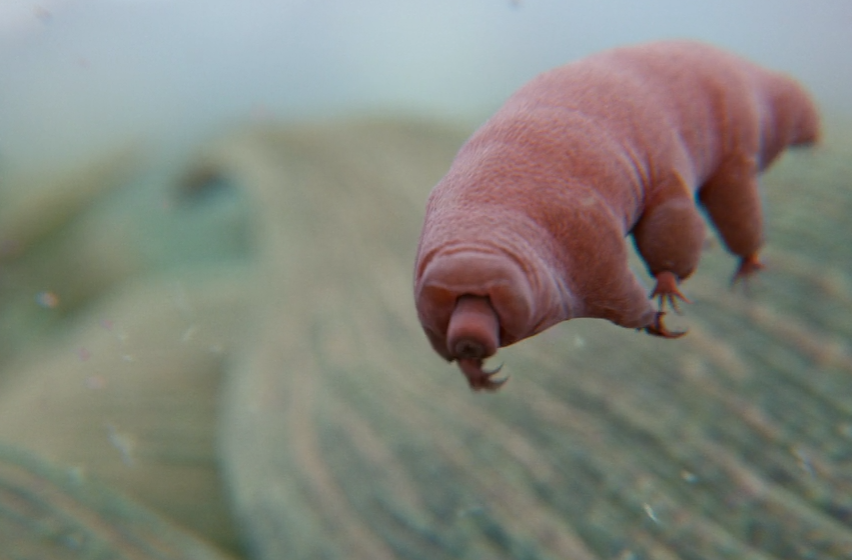
The Tiny Animal That Can Survive Almost Anything
Meet the tardigrade: a tiny “water bear” whose extraordinary survival skills could teach us how to protect life on Earth – and beyond.
Barely visible to the naked eye, the microscopic tardigrade has eight stubby legs and looks like a cross between a caterpillar and a miniature bear. Yet it may be one of nature’s most remarkable survivors.
Also known as a “water bear,” the tardigrade is a tiny animal found in oceans, freshwater, and even in mosses and lichens. More than 1,000 species have been identified. Most are only about 0.25 to 0.50 millimeters (0.01 to 0.02 inches) long.
Its real superpower is its extraordinary ability to shut down almost completely when conditions become unbearable. In this state, tardigrades can survive environments that would kill most other forms of life.
Life on Pause
When water disappears, some tardigrades lose almost all the water in their bodies and curl into a compact, dehydrated form called a “tun.” They enter a state known as anhydrobiosis, in which metabolism virtually stops.
This is one form of cryptobiosis, a reversible state in which biological activity falls to an extremely low level. When water returns, the tardigrade can rehydrate and resume normal activity. Research indicates that some tardigrades can remain in this suspended state for years and, in exceptional cases, even decades.
And while dormant, they can withstand conditions that would be fatal to most animals.
Extreme Survival Skills
Depending on the species and circumstances, tardigrades can survive intense dehydration, freezing, extreme heat, enormous pressure, and high doses of radiation. Remarkably, some have survived exposure to the vacuum of space.
In one experiment, tardigrades were exposed outside a spacecraft in low Earth orbit. Some survived the combination of space vacuum and cosmic radiation, although exposure to unfiltered solar ultraviolet radiation proved much more damaging.
The animals’ radiation resistance is particularly striking. Some species can survive exposure to several thousand grays, a measure of absorbed radiation. For humans, a whole-body dose of only 4–5 grays can be lethal.
How do they do it? Scientists are still piecing together the answer. Tardigrades appear to use several protective strategies involving proteins, antioxidants, and DNA repair. One protein, known as Dsup – short for “damage suppressor” – can bind to DNA and reduce radiation-induced damage. In a 2016 study, human cells engineered to produce Dsup experienced about 40% less X-ray-induced DNA damage.
From Water Bears to Human Health
This extraordinary biology has attracted attention well beyond zoology.
Researchers are investigating whether tardigrade proteins could eventually help protect human cells from radiation or other forms of cellular stress. This could have implications for areas ranging from cancer treatment to the preservation of biological materials.
A particularly intriguing recent development came in 2026, when researchers reported that proteins found in tardigrades could help protect synthetic cells from dehydration, heat, and osmotic stress. Osmotic stress occurs when a sudden shift in surrounding water or salt levels disrupts a cell’s balance, causing it to shrink or burst. The findings point towards possible applications in biotechnology and the storage of biological materials without conventional cold-chain systems.
Could They Help Us Age Better, or Travel Farther?
Tardigrades are also offering clues about a question that matters to everyone: how cells protect themselves from damage over time.
Anhydrobiosis effectively pauses many biological processes, including processes associated with aging. Scientists are investigating the mechanisms that allow tardigrades to protect DNA and cellular structures during this suspended state. Recent experiments have even found that introducing the gene for the tardigrade’s Dsup protein into a tiny laboratory worm increased its resistance to oxidative stress – cellular damage caused by harmful, highly reactive molecules – and extended its lifespan. That’s an intriguing finding, although it is still far from a human anti-aging treatment.
Space is another frontier. NASA has used tardigrades aboard the International Space Station to investigate how their genes respond to the stresses of spaceflight. The hope is that understanding their resilience could eventually contribute to ways of protecting astronauts during long missions.
Small Creature, Big Lessons
The tardigrade is not immortal and its survival abilities vary considerably between species and conditions. Scientists cannot simply transfer its extraordinary powers to humans.
Rather than providing a ready-made solution, the tiny water bear offers a remarkable biological blueprint. By studying how one of Earth’s smallest animals protects its DNA, stabilizes its cells, and survives when almost everything else fails, researchers may discover new ways to preserve life in some of the most challenging environments, from a hospital laboratory to the far reaches of space.
