
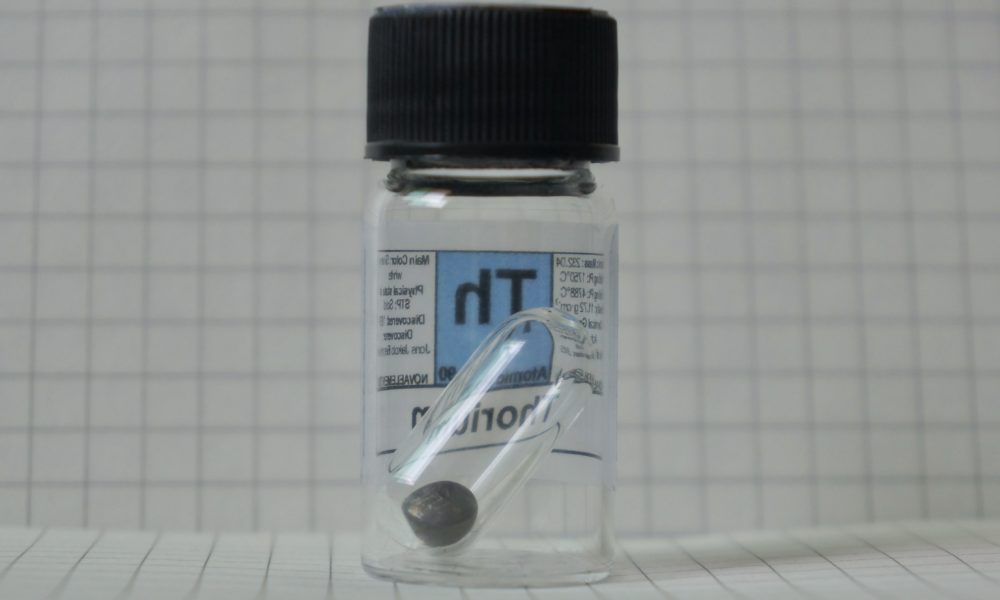
Thorium – A Tantalizing Energy Prospect to Power the Future
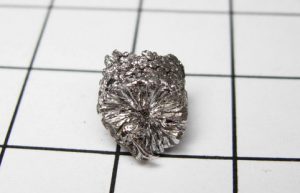
Thorium (Image: Chemistry Learner)
Could a little-known metal help power a cleaner energy future? Thorium is attracting growing attention as scientists and engineers explore a new generation of nuclear reactors that could provide abundant, reliable, low-carbon energy.
In 1828, Swedish chemist Jöns Jacob Berzelius discovered thorium, a light silver metal that is moderately soft, malleable, and has a high melting point. It occurs naturally in minerals such as monazite and thorite in the Earth’s crust. Berzelius named the metal after Thor, the Norse god of thunder. Although it is radioactive, it decays so slowly that its radioactivity is relatively low.
From Thorium to Nuclear Power
Thorium is interesting because when it absorbs a neutron, it eventually becomes uranium-233, a form of uranium that can sustain a nuclear chain reaction. Unlike uranium-235, thorium does not need to be enriched before it can be used. Once uranium-233 is produced, it can split apart and release heat and more neutrons, which can convert more thorium into uranium-233. Under the right conditions, a reactor can produce more fissile material than it consumes.
Chinese engineers have seized on these characteristics to create a thorium-based reactor in the Gobi Desert that is safer than a traditional uranium nuclear reactor, even if the power fails. Unlike conventional nuclear reactors, which use water to transfer heat from the nuclear reaction, the Chinese reactor uses molten fluoride salt as both the coolant and the carrier for the nuclear fuel. The salt can operate at very high temperatures without boiling and at much lower pressure than water. This reduces the risk of high-pressure accidents and explosions associated with conventional water-cooled reactors. The molten salt is also non-flammable, so it cannot catch fire.
Salt as the Medium
Salt also offers another important safety advantage. If the reaction gets too hot and out of control, the atoms move farther apart. This reduces the number of nuclear reactions and brings the temperature back down. In this way, the reactor is self-regulating.
Compare that to a traditional power plant, where the water evaporates and the plant overheats and melts down. There is no way to stop the chain reaction when it has started, other than running out of the fuel.
When a thorium reactor is in operation, energy from nuclear fission heats the molten salt. Heat exchangers then transfer this heat to water, producing steam that drives turbines to generate electricity.
Abundant and Powerful
Thorium has an extraordinarily high energy potential. According to estimates published in the scientific literature, 1 metric ton of the metal could produce as much energy as around 200 metric tons of uranium or 3,500,000 metric tons of coal. The International Atomic Energy Agency estimates that around 6 million tons of thorium exist worldwide (although not all of these resources are necessarily economically recoverable). Given its abundance and immense energetic capacity, thorium could be a viable long-term solution for global power needs.
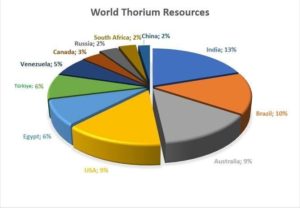
World thorium reserves (© BravoSierraGolf, reddit)
The Challenges Ahead
But significant challenges remain:
- The fission process produces radioactive materials that must be handled and managed safely. Engineers and technicians may need robots and other remote systems for tasks such as handling materials and carrying out maintenance in highly radioactive areas.
- The fission process also produces unwanted products that can interfere with reactor operation. Researchers at Delft University of Technology in the Netherlands are investigating how helium bubbles can help remove some of these materials, such as gaseous products and tiny metallic particles, from the molten salt.
- The reactor materials must tolerate high temperatures, corrosive molten salts, and intense radiation. Thus, engineers are developing and testing specialized alloys, such as Hastelloy N, designed to withstand the demanding conditions inside a molten-salt reactor.
Building the Future
Companies worldwide have taken note and are pursuing molten-salt and other advanced nuclear technologies that could make greater use of thorium:
- Copenhagen Atomics, Denmark, developing thorium-based molten-salt reactors with a focus on low electricity prices and rapid installation
- Flibe Energy, United States, researching liquid-fluoride reactors, including a design specifically aimed at using the thorium fuel cycle
- Thorizon, Netherlands/France, investigating molten-salt reactor technology designed to use nuclear waste as fuel, with plans for a demonstration reactor in the Netherlands
- Thorkraft, Norway, pursuing thorium-based molten-salt reactor development and working toward the necessary regulatory approvals
In addition, other companies and countries are making important advances in the molten-salt reactor field without necessarily building thorium reactors. Thor Energy in Norway, for example, is working on thorium-based nuclear fuel for existing and advanced reactors. China is probably the most significant player in terms of actual thorium reactor research. The Shanghai Institute of Applied Physics, part of the Chinese Academy of Sciences, has been developing the Thorium Molten Salt Reactor program. The country has already operated a small 2-megawatt thermal experimental molten-salt reactor, which reached full power in 2024. In 2025, it achieved the first reported conversion of thorium into uranium-233 in a molten-salt reactor.
In India, the Bhabha Atomic Research Centre is developing the Advanced Heavy Water Reactor, a component of a long-standing national strategy aimed at the eventual large-scale use of thorium. The 300-megawatt reactor is designed to demonstrate how thorium could be used extensively to generate commercial nuclear power. But it is not yet an operating reactor.
These activities are helping advance the technologies needed to make nuclear power more efficient, sustainable, and potentially safer. At the same time, they show that thorium could play an important role in the future of low-carbon energy. Although significant technical and economic challenges remain, the rapid progress in thorium and molten-salt research offers reason for optimism. A new generation of nuclear technology could eventually deliver abundant, reliable, and low-carbon energy, and help power a more sustainable future.