
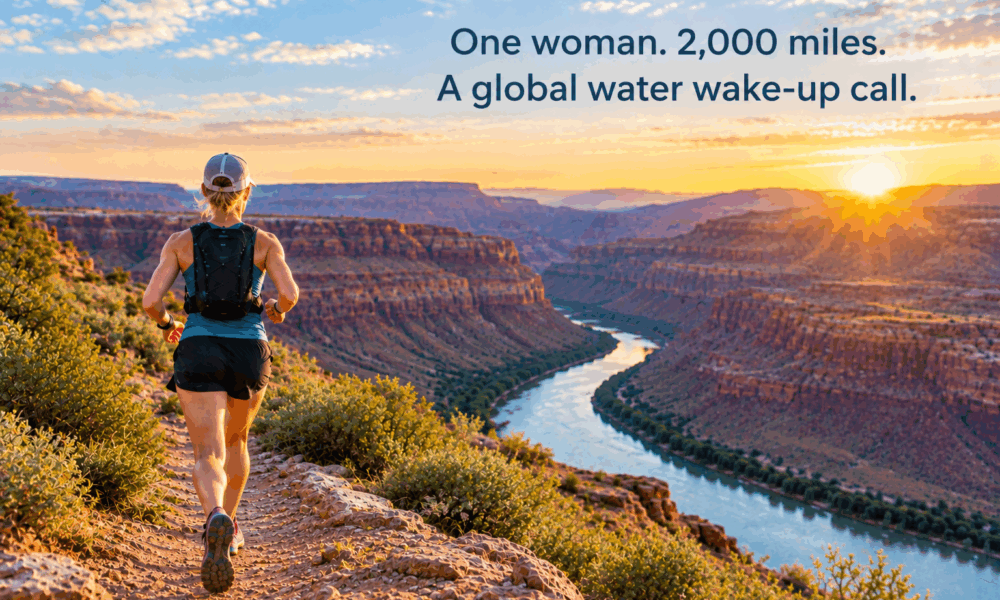
One Woman, 2,000 Miles and a Global Message About Water
How Mina Guli is turning an epic run into a powerful tool for awareness, collaboration, and action on the world’s water crisis
What can one person do about a global problem as enormous as water scarcity?
Mina Guli’s answer is simple: start moving.
A few days ago on September 17, Australian water advocate and ultrarunner Mina Guli completed yet another astonishing feat. She ran more than 2,000 miles (±3,218 km) along the Colorado River. She crossed the finish line in Los Angeles after 92 days.
Her goal was about much more than running a very long way. It was to make the water crisis impossible to ignore and to bring people together to do something about it.
Mina’s awe-inspiring runs over the years have done more than generate publicity for individual rivers and waterways. She has used physical challenges as a communications and convening tool to make the global water crisis more visible, personal, and actionable.
Here are the main ways her exploits are making a difference:
-
Turning an abstract global crisis into something people can see
Water scarcity can be difficult to grasp when expressed through statistics about drought, reservoirs, or water consumption. By running the length of the Colorado River, Mina has put herself directly in the landscapes and communities that depend on it. She has described the run as a “stunt” that gets people’s attention, but also as a way to meet people on the front lines and hear their experiences.
That gives her a powerful storytelling role: she can take those first-hand observations and conversations to audiences who may live hundreds or thousands of miles from the river.
-
Connecting local water problems to the global crisis
The Colorado River is an unusually powerful case study. It supplies water to about 40 million people and supports major agricultural, industrial, and urban economies. At the same time, the basin has been under prolonged drought and faces difficult decisions over how a diminishing water supply should be shared.
What happens on the Colorado is therefore not simply an American problem. It offers lessons for other regions facing growing pressure on their water resources. Mina has described the river as a potential “blueprint” for bringing communities, governments, and companies together to find solutions.
-
Bringing people together rather than simply raising awareness
This may be the most significant aspect of the campaign.
The Keep the River Running initiative has included regional summits in Denver, Las Vegas, Phoenix, and Los Angeles, bringing together people from business, government, utilities, academia, Tribal communities and nonprofit organizations. The discussions focused on practical measures such as water efficiency, wastewater reuse, infrastructure modernization, and collaboration across sectors.
The run therefore became a door-opener for conversations among people who normally operate in separate spheres.
-
Giving business a role in solving the problem
Mina argues that addressing water scarcity requires collaboration beyond governments and water agencies. Her campaigns have deliberately involved companies and other organizations in exploring ways to reduce water consumption and strengthen water resilience.
Her broader Thirst Foundation has been using endurance running to bring water challenges to public attention for years. In 2022, for example, Mina ran 200 marathons in 32 countries while documenting the water crisis and exploring solutions.
-
Creating a human story that media can carry much further
The sheer scale of the latest challenge – 2,000 miles in less than 100 days through extreme heat, wildfire-affected areas, and difficult terrain – gives journalists and social-media audiences a memorable way into an otherwise complicated policy issue.
Instead of simply reading about water scarcity, people can follow one person exposing the reality of it day after day. That shows this vast global problem as immediate and human.
-
Shifting the conversation from scarcity to solutions
An interesting element of Mina’s message is that she does not want the conversation to stop at “How do we divide less water?”
She has used the metaphor of making a “pie factory” rather than simply dividing an ever-smaller pie. The idea is finding ways to increase water resilience through conservation, reuse, efficiency, infrastructure, and other innovations.
That gives her campaigns a constructive dimension. The objective is not simply to warn people that a waterway is in trouble but to encourage them to ask what they, and we all, can actually do about it.
And the Colorado River campaign has now moved beyond awareness. At the final Los Angeles summit, participating communities, farmers, Tribal representatives, and companies announced a shared plan focused on water savings and investments in measures to strengthen the river basin’s resilience.
The Bigger Picture
Mina’s run cannot solve the Colorado River crisis by itself. The river’s management involves complex issues arising from decades of drought, water allocations, agriculture, cities, Tribal water rights, infrastructure, and interstate negotiations.
Its contribution is different. Mina has used an extraordinary personal challenge to make an enormous, complicated problem visible; connect the people experiencing it with decision-makers; showcase solutions; and carry the lessons of one river to a global audience.
Her 2,000-mile journey is a powerful reminder that changing the world does not always begin with an institution, a government, or a large organization.
Sometimes, it begins with one person willing to take the first step – and then keep going, mile after mile.