
From “Impossible” to Impact: The Ocean Cleanup Gains Momentum
A bold vision is becoming reality, combining ocean barriers and river Interceptors to tackle plastic pollution at its source and in the sea.
When we last looked at The Ocean Cleanup in October 2022, Boyan Slat’s ambitious mission was still very much a work in progress. Today, the picture is considerably more encouraging. The nonprofit organization he founded in 2013 at just 18 has now removed 50 million kilograms (50,000 metric tonnes) of trash from aquatic environments worldwide, reaching that milestone in March 2026.
Slat’s original insight was deceptively simple: rather than chasing plastic across the ocean, why not use the ocean’s currents to bring it together? His floating barriers act like an artificial coastline, concentrating plastic so it can be collected and removed. The idea that began with a teenager’s school project and a 2012 TEDx talk has evolved into a sophisticated international engineering and research effort.
Tackling the Great Pacific Garbage Patch
The greatest test is the Great Pacific Garbage Patch (GPGP), the world’s largest accumulation of floating plastic, located between Hawaii and California. The Ocean Cleanup estimates that about 100,000 tonnes of plastic are circulating there. That’s equivalent to the weight of more than 740 Boeing 777 aircraft. Much of it consists of fishing gear and other large plastic objects, along with smaller fragments. Left in the ocean, these larger items gradually break down into smaller pieces and eventually microplastics. Marine animals can swallow these tiny particles, potentially causing physical harm and allowing plastic-associated chemicals to move through the ocean’s food chain.
Since capturing its first plastic from the GPGP in 2019, The Ocean Cleanup has progressively refined its technology. Its current system, System 03, was fully deployed in August 2023. Almost three times larger than its predecessor, it can at peak efficiency sweep an area equivalent to a football field every five seconds. In late May 2024, the organization completed its 100th extraction from the GPGP, having by then removed more than 385,000 kg of plastic from the patch.
The next challenge is scale. Rather than simply deploying larger barriers, the team is using computer modeling, artificial intelligence, drones, and other technologies to identify constantly shifting plastic “hotspots.” According to the organization, this should allow future operations to collect considerably more plastic while using less time, fuel, and energy.
Turning Off the Tap
But cleaning up the ocean alone cannot solve the problem. Plastic must also be stopped before it gets there.
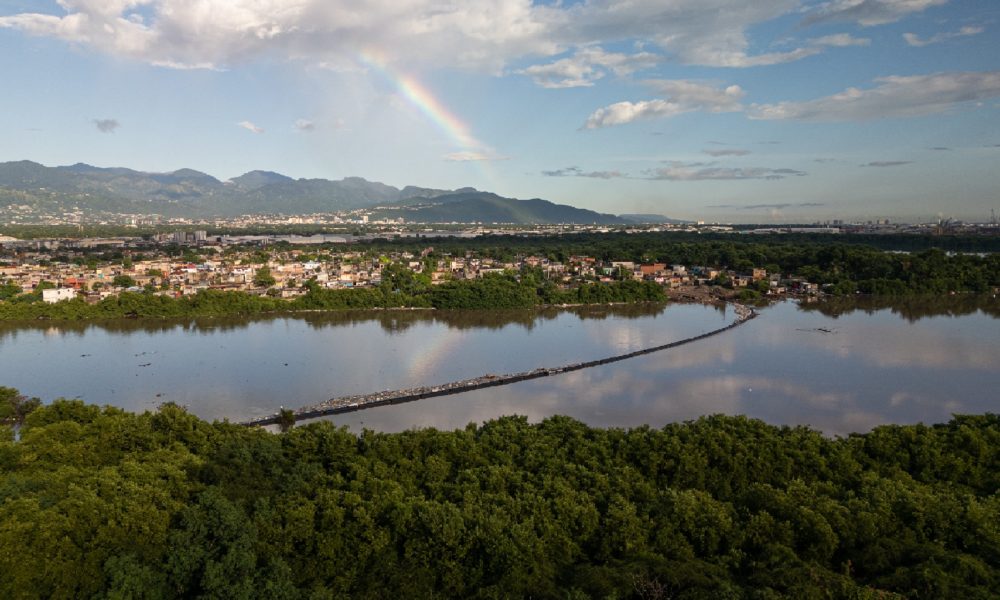
Research by The Ocean Cleanup found that roughly 1,000 rivers, just 1% of the world’s rivers, account for nearly 80% of riverine plastic entering the oceans. The company’s Interceptor technology uses floating barriers and collection systems to capture waste carried downstream before it reaches the sea.
The results are already substantial. In 2024, the Rivers program extracted more than 11 million kg of waste. That brought the total removed through river operations to above 20 million kg.
And the ambition is now growing dramatically. In 2025, The Ocean Cleanup launched its 30 Cities Program, aiming to reduce river-borne plastic entering the oceans by up to one-third by 2030. The initiative will require an estimated $350 million in total. In March 2026, it received a major boost when the Audacious Project committed $121 million toward the program. Planned deployments include cities such as Mumbai, Jakarta, Kuala Lumpur, Panama City, Manila, and Santo Domingo.
From Impossible to Achievable
Slat’s ultimate goal is audacious: to remove 90% of floating ocean plastic by 2040. After years of experimentation, setbacks, and technological breakthroughs, that ambition no longer sounds quite so impossible.
The Ocean Cleanup is pursuing a two-part strategy: to turn off the tap by stopping plastic in rivers, while mopping up the legacy pollution already accumulated in the oceans. It is also using science, AI, and engineering to make each generation of its technology more effective.
That may be the most encouraging lesson of all. Some of the world’s biggest environmental challenges can look overwhelming, until someone asks a deceptively simple question: Why can’t we clean it up?