
Infinite Pie, Infinite Curiosity: Celebrating Pi Day and Einstein’s Birthday
The surprising history behind the world’s favorite math holiday
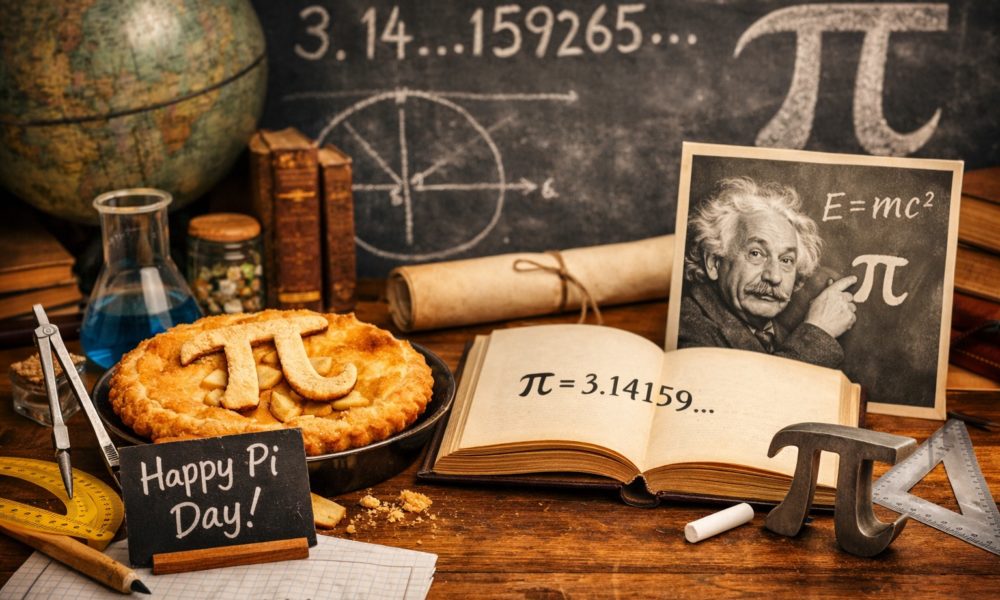
Every year on March 14, math lovers, scientists, teachers, and pie enthusiasts unite for one of the nerdiest, and tastiest, holidays on the calendar: Pi (π) Day. The date, written as 3/14, mirrors the first three digits of the mathematical constant pi, approximately 3.14. But the day holds another delightful coincidence. It’s also the birthday of one of the greatest scientific minds in history, Albert Einstein, born on March 14, 1879.
First, there’s the star of the show: π. Pi is the ratio of a circle’s circumference to its diameter. This constant begins 3.14159… and continues forever without repeating. That means mathematicians could keep calculating its digits indefinitely, and people have tried. Modern computers have now computed pi to trillions of digits, even though only a handful of digits are needed for most practical calculations.
The number itself has fascinated thinkers for thousands of years. Ancient mathematicians such as Archimedes (287-212 BCE) studied the relationship between circles and this mysterious ratio long before the symbol π was adopted. The Greek letter was first used to represent the number in 1706 by Welsh mathematician William Jones (1675-1749). Swiss mathematician Leonhard Euler (1707-1783) later helped popularize its use.
But Pi Day as a celebration didn’t begin until much later. According to the American Mathematical Society (in its magazine Notices, p. 304), physicist Larry Shaw organized the first official Pi Day event in 1988 at the Exploratorium science museum in San Francisco. On that occasion, participants marched around a circular space and ate fruit pies. Yes, actual pie is a traditional part of Pi Day festivities. In 2009, the U.S. House of Representatives officially designated March 14 as National Pi Day, passing a congressional resolution to promote math education.
And then there’s Einstein.
The coincidence that Pi Day falls on Albert Einstein’s birthday feels almost too perfect. The theoretical physicist, famous for the equation E = mc² and his groundbreaking work on relativity, spent the final decades of his life in Princeton, New Jersey. There he continued to reshape physics and our understanding of the universe. While pi itself isn’t directly tied to Einstein’s discoveries, mathematics like this forms the foundation of physics. It helps explain everything from planetary motion to the curvature of space-time.
Today, Pi Day celebrations range from classroom math games to worldwide recitation contests, where enthusiasts compete to memorize thousands of digits of π. Some universities host pie-baking competitions, while space agencies such as NASA release Pi Day challenges that use real mission data.
So on March 14, you have the perfect excuse to celebrate three things at once: a mysterious number that never ends, a brilliant scientist who changed the world, and a slice of your favorite pie.
After all, when curiosity and dessert meet, that’s a formula worth remembering.