
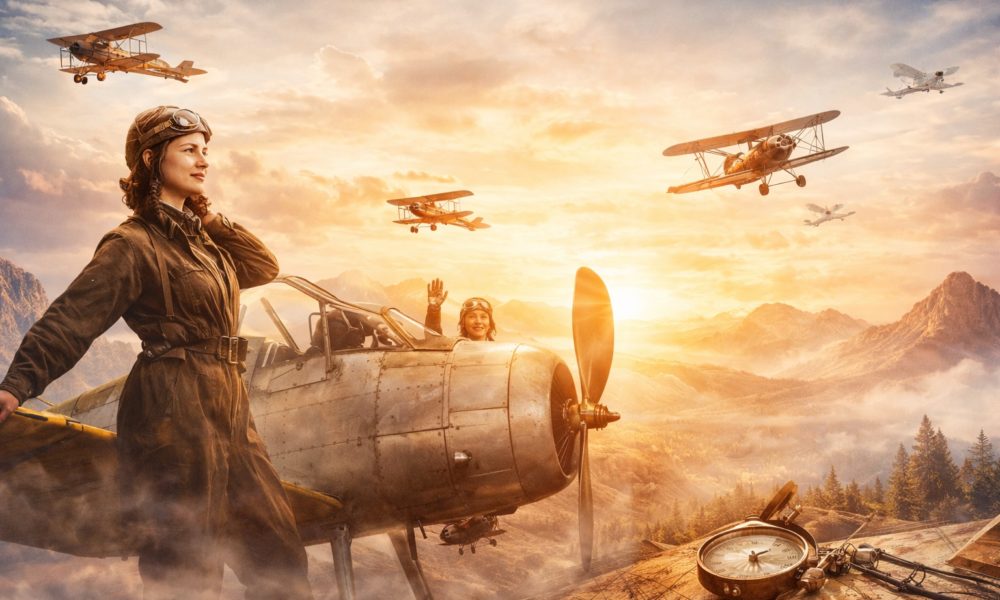
Five Fearless Women Who Changed the History of Flight
The daring aviators who proved the sky was never the limit
Every year on International Women’s Day (March 8), the world celebrates women who broke barriers and reshaped society. While many stories highlight political leaders, scientists, and activists, aviation history also owes much to a group of daring women who risked their lives in fragile aircraft to push the limits of what was possible.
In the early decades of flight, when planes were little more than wood, canvas, and hope, these pioneers crossed oceans, mountains, and continents. Their courage not only set aviation records but also shattered assumptions about what women could achieve.
Here are five extraordinary aviators whose stories still inspire today.
Adrienne Bolland: The woman who defied the Andes
Adrienne Bolland, born in 1895 in Arcueil, France, would become one of the most daring test pilots of her era. In 1921, she set herself an almost impossible challenge: flying across the towering Andes mountains between Mendoza in Argentina and Santiago in Chile.
Her aircraft, a fragile Caudron G.3, could barely reach about 14,800 feet (4,500 meters), far below the peaks of the Andes, where summits like Aconcagua soar to 22,837 feet (6,960 meters). On April 1, 1921, Bolland took off anyway, flying without a windshield or enclosed cockpit, and with no map, compass, or oxygen while navigating through narrow mountain valleys. After 4 hours and 17 minutes of flight in freezing temperatures and violent winds, she successfully landed in Santiago, completely exhausted, disoriented, oxygen-deprived, and dizzy, barely able to stand. But she had become the first woman to fly across the Andes.
The achievement was so unbelievable that the French ambassador initially dismissed the news as an April Fool’s joke and skipped the celebration. In 1924, she performed 212 aerial loops in just 72 minutes, spinning her plane in daring vertical circles, a feat that showcased her extraordinary skill and set a world record. That year, France finally recognized her brilliance when she received the Chevalier (Knight) of the French Legion of Honor in belated recognition of her Andes flight.
During World War II, Bolland joined the Resistance intelligence network Confrérie Notre-Dame, which was affiliated with the Free French Forces. For her wartime service, she was promoted in 1947 to the higher rank of Officer of the French Legion of Honor. In addition to her lifetime awards, she was honored with a street and school named after her in Poissy, a suburb of Paris and, in 2005, the French postal service issued a postage stamp in her honor.
Amelia Earhart: The aviator who captured the world’s imagination
Few names in aviation are as legendary as Amelia Earhart.
Born in Kansas in 1897, Earhart first encountered aviation while working in a military hospital during World War I, where wounded pilots shared stories of flying. Inspired, she began flying lessons and quickly developed a reputation for boldness.
In 1932, she became the first woman to fly solo across the Atlantic Ocean, five years after Charles Lindbergh made the crossing famous. For this feat she received the American Distinguished Flying Cross, becoming the first woman ever awarded the honor.
Earhart was also instrumental in founding The Ninety‑Nines, an international organization for women pilots.
Her most ambitious journey began in 1937, when she and navigator Fred Noonan attempted to fly around the world, a distance of about 24,855 miles (40,000 km). After completing most of the route, their plane vanished over the Pacific near Howland Island, creating one of aviation’s greatest mysteries.
Nearly nine decades later, researchers still search for clues. A new investigation planned by Purdue Research Foundation aims to locate the wreckage near Nikumaroro, a remote Pacific island where some believe the aircraft may have gone down.
Maryse Hilsz: France’s record-breaking sky adventurer
Born Marie-Louise Hilsz in 1901 near Paris, Maryse Hilsz first gained fame performing breathtaking stunts, including parachute jumps and even standing on the wings of moving aircraft.
But she soon proved far more than an entertainer. After earning her pilot’s license in 1930, Hilsz became one of France’s most accomplished record-setting aviators. During the 1930s, she completed astonishing endurance flights, including round trips from Paris to Saigon and Tokyo, covering tens of thousands of miles.
She also dominated altitude records. In 1936, Hilsz set a women’s world altitude record of about 47,000 feet (14,300 meters) in a propeller-driven aircraft, an extraordinary achievement for the era.
During World War II, she flew missions supporting the French Resistance. She was later made a Chevalier (Knight) of the French Legion of Honor in recognition of her achievements as one of France’s leading female aviators. Tragically, she died in a plane crash in 1946.
Amy Johnson: The “Queen of the Air”
Born in Kingston upon Hull, England in 1903, Amy Johnson would accomplish one of the most remarkable solo journeys in aviation.
In May 1930, the British pilot flew alone from London, England to Darwin, Australia, covering roughly 11,000 miles (17,700 km) in her aircraft, the de Havilland DH.60 Gipsy Moth. She relied only on maps and a compass, without radio communication or reliable weather forecasts. When Johnson landed in Darwin on May 24, 1930, she became the first woman to complete the solo flight from Britain to Australia, instantly becoming an international celebrity. The British press crowned her the “Queen of the Air.”
In 1932, Johnson married fellow record-breaking pilot Jim Mollison. Together they attempted some of the most ambitious long-distance flights of the era. In 1933, they set out to break the east-to-west transatlantic record, taking off from Pendine Sands in Wales bound for New York City. Celebrated by the press as the “flying sweethearts,” the couple battled poor weather and dwindling fuel before crash-landing at Bridgeport, Connecticut. Both were injured, and the accident ended their attempt to claim the record.
Undeterred by this setback, Johnson kept flying. She contributed to the war effort as part of the Air Transport Auxiliary. In 1941, her life ended tragically when her Lockheed Hudson crashed into the Thames Estuary during a ferry flight, cutting short the career of one of Britain’s most celebrated aviators.
Jean Batten: The “Garbo of the Skies”
New Zealand aviator Jean Batten became one of the most celebrated pilots of the 1930s.
Born in Rotorua in 1909, Batten trained as a pilot in England before embarking on a series of pioneering long-distance flights. In 1934, she flew solo from England to Australia in 14 days, 23 hours, and 25 minutes, breaking Amy Johnson’s previous speed record.
Batten continued to capture aviation headlines with a string of remarkable solo flights. In 1935, she became the first woman to fly alone from Australia back to England. She followed this with a solo flight from England to Argentina, setting a new long-distance record for a woman. In 1936, she completed a direct solo flight from England to New Zealand, marking her final major long-distance record. This achievement established her as one of the world’s foremost long-distance aviators.
By the end of the decade, Batten was an international celebrity. Her remarkable skill, poise, and elusiveness off the public stage earned her the nickname “Garbo of the Skies.” The name was a nod to the Hollywood actress Greta Garbo, famous for her glamorous presence and reclusive nature. Batten’s ability to command attention without seeking it made her a legendary figure in aviation.
Her achievements earned her the prestigious FAI Gold Air Medal from the Fédération Aéronautique Internationale, making her the first woman to receive the honor. Despite her fame, Batten withdrew from public life later in the decade, publishing her autobiography, My Life, in 1938.
The Legacy of Aviation’s Fearless Women
Long before modern navigation systems or pressurized cabins, these pioneers flew through storms, over oceans, and across mountain ranges with little more than determination and courage.
On International Women’s Day, their stories remind us that progress often begins with individuals willing to challenge the impossible. Thanks to women like Adrienne Bolland, Amelia Earhart, Maryse Hilsz, Amy Johnson, and Jean Batten, aviation, and the world, would never be the same.