
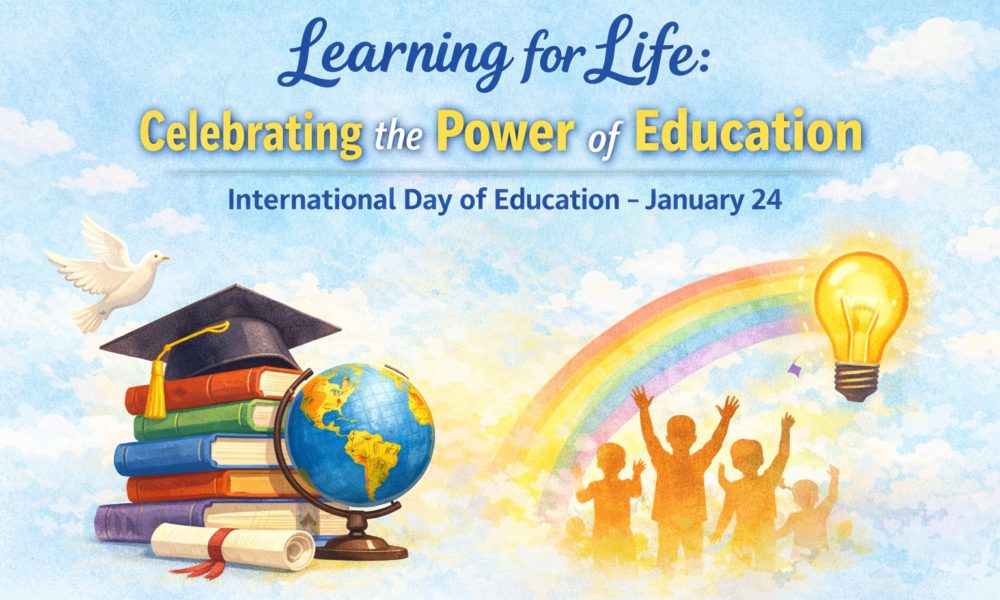
Learning for Life: Celebrating the Power of Education
Why January 24 Matters and How You Can Support Education All Year Long
Every January 24, people around the globe pause to celebrate the International Day of Education, a joyful reminder of how transformative learning can be for individuals, communities, and all of humanity. This special day is about far more than marking a date on the calendar: it’s about cherishing the opportunity to grow, think, create, and connect through education.
Why January 24 Matters
The United Nations General Assembly proclaimed January 24 as the International Day of Education in December 2018, recognizing education as a universal human right and a cornerstone for peace and sustainable development. The first celebration took place in 2019 and, every year since, this day has served as a call to action: to improve access, fight inequality, and promote lifelong learning for everyone, no matter their background or circumstance.
On this day, educators, learners, policymakers, and everyday citizens alike celebrate education’s role in advancing human dignity and opportunity. It also highlights ongoing challenges: UNESCO reports that, even today, around 250 million children and youth are out of school, and over 760 million adults remain unable to read and write, despite the world’s collective progress.
A Brief Look at the Origins of Formal Education
The idea of structured, formal education, where learners follow a set curriculum in schools, has roots that stretch back thousands of years, evolving with the needs of human societies. The earliest known formal schools appeared in ancient Egypt during the Middle Kingdom (around 1980–1760 BCE). At that time, privileged youth, scribes, and administrators were trained in writing, arithmetic, and governance, skills vital to running a complex society.
Across ancient Mesopotamia, China, India, Greece, and Rome, systems of education developed independently, often tied to religious institutions, government administration, or community values. In Europe, formal education expanded during the Middle Ages through monastic schools and later through medieval universities such as Bologna and Paris, which became centers of learning for scholars from across the continent.
Today’s schools, colleges, and universities trace a lineage to these ancient beginnings, evolving ever more inclusive models while maintaining education’s core purpose: to equip individuals with the knowledge and skills needed to understand the world and shape their own lives.
Why Education Is So Important
Education is more than schooling. It’s empowerment. It gives individuals the tools to think critically, communicate effectively, and make informed decisions. According to the United Nations, education is a key driver of poverty reduction, gender equality, and healthy societies. UNESCO and the Organisation for Economic Co-operation and Development (OECD) further highlight education’s role in fostering creativity, innovation, and social cohesion, while the World Bank emphasizes its impact on economic growth and inequality reduction.
What’s more, research highlighted by UNESCO, UNICEF, the World Bank, and the OECD shows that educated mothers are more likely to ensure their children receive education as well, improving outcomes across generations. Having a literate population also contributes to economic growth, civic participation, and better health outcomes. Simply put, education unlocks opportunity on both personal and societal levels.
How You Can Promote Education All Year Round
The International Day of Education isn’t a one‑day affair. It’s a year‑round invitation to support learning in your family, community, and beyond. Here’s how you can help:
- Support local schools and learners. Whether through tutoring, donating books, or volunteering your time, your involvement can make a real difference. Even simple gestures, like helping a child read or explore math, can have a meaningful impact.
- Share the joy of learning. Talk about what you’re learning with friends or family, join community education events, or simply encourage others to pursue new knowledge. Curiosity is contagious!
- Advocate for equal access. Education systems should be inclusive and equitable. Support organizations and policies that expand opportunities for girls, underserved communities, refugees, and adults returning to learning.
- Embrace lifelong learning. Education doesn’t stop after school or college; it continues through life. Take a class, learn a language, pick up a hobby, or explore a new topic online. Lifelong learners not only enrich their own lives but inspire others too.
A Day to Celebrate and a Reason to Act
As we mark International Day of Education on January 24, let’s honor the teachers, learners, and advocates who make education possible. Let’s also remember that each of us has a role to play, whether small or large, in making education more inclusive, joyful, and effective, across generations and for all people.
Every page turned, every question asked, and every mind opened brings us one step closer to a more educated, peaceful, and equitable world. Let’s keep learning and keep lifting others up with us.